10, February 2026
Development Of Green Skills For A Changing World
Skill development is no longer considered optional; it is a critical necessity for survival and growth in a rapidly transforming world. Driven by global megatrends such as artificial intelligence (AI), automation, and the green transition, the nature of work is evolving so fast that traditional qualifications alone are no be longer enough to ensure long-term career security. Skill development is the deliberate process of building and refining the abilities and knowledge required to perform tasks effectively. Development of skills makes individuals more competitive in the job market, opening doors to higher-paying opportunities and protecting against job displacement. Mastering new skills boosts self-esteem, reduces imposter syndrome, and provides a sense of fulfillment. Skilled individuals’ complete tasks faster and with fewer errors, leading to better work-life balance as they can disconnect from work more easily.
In recent years, the conversation surrounding environmental sustainability has gained significant traction globally. Environmental challenges like climate change, biodiversity loss, and pollution are global crises that disproportionately affect the world's populations. Simultaneously, there is a lack of the populace preparedness for the burgeoning green jobs market, leading to both high unemployment and an under-skilled workforce for sustainability roles. In fact, according to the International Labour Organization (ILO), the transition to a greener economy could create 24 million new jobs globally by 2030. But to access these green jobs, individuals need the right skills. A report by LinkedIn highlights that demand for green skills is rising twice as fast as the number of people who actually have them. That means people who invest in these skills will stand out in the job market.
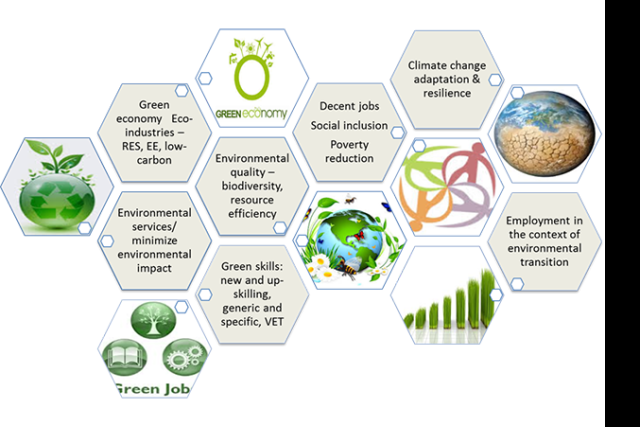
Green skill is an umbrella term for the knowledge, behaviours, capabilities and technical skills required to tackle the environmental challenges we face and to unlock new opportunities for growth. Simply put, green skills are the knowledge, abilities, values and attitudes needed to live in, develop and support a sustainable and resource-efficient society. The United Nations Framework Convention on Climate Change (UNFCCC) defines green skills as technical knowledge, expertise and abilities that enable the effective use of green technologies and processes in professional settings. Today, green skills have shifted from niche expertise to a skill of global demand as nearly every job is becoming a climate-impacted role.
Common green skills that are of global demand include: (i). Skills in installing and maintaining solar panels, wind turbines, and other clean energy systems. (ii). Knowledge of energy-efficient design, sustainable construction materials, and retrofitting existing buildings. (iii). Skills in waste management (becoming an expertise in recycling, composting, and implementing circular economy principles to minimise waste). Knowledge of recycling, waste reduction (following the 4Rs: Refuse, Reduce, Reuse, Recycle), water conservation, and wastewater treatment processes. Skills related to using sustainable building materials, green building certifications (e.g., LEED), and designing energy-efficient structures.
Developing green skills is a proactive strategy for individuals to future-proof their careers as industries rapidly transition toward sustainability. This development involves a combination of formal education, practical application, and lifestyle shifts. Developing these skills requires (i) Integrating sustainability into formal education curricula from an early age. (ii). Expanding vocational training, apprenticeships, and on-the-job upskilling programs. (iii). Strong collaboration between public and private sectors to ensure training aligns with industry needs. (iv). Policy and funding support to drive action and make training accessible to all members of society. (v). Target online certifications in high-demand areas such as carbon footprinting, climate data analysis, and sustainability reporting.
(vi). Learn system thinking skills to analyze how different parts of an organization or ecosystem interconnect to identify root causes of environmental impact. (vi). Practice design thinking to create sustainable solutions that balance environmental health with business needs. (vii) Develop empathy and self-regulation to navigate highly politicized topics like climate justice and the green transition. (viii). Learn and practice the 4R Principle (Reduce, Reuse, Recycle, Recover) in daily waste management.
Conclusively, green skills are the bridge between traditional economic models and a sustainable future, ensuring that the workforce is prepared for the challenges and opportunities of a changing world. This encompasses both technical (hard) skills related to specific green technologies (e.g., solar energy installation, waste management) and transversal (soft) skills such as systems thinking, problem-solving, and adaptability.
Prof. Akpofure Rim-Rukeh
(FNES, COREN, MNSE, FECRMI, FFCSN, FNiSafetyE, FNiCA)
CEO - Sustainable Future Academy Limited.
0 |
0 |
|